
on rejection

When writers talk about rejection, they’re usually talking about those notes like these:
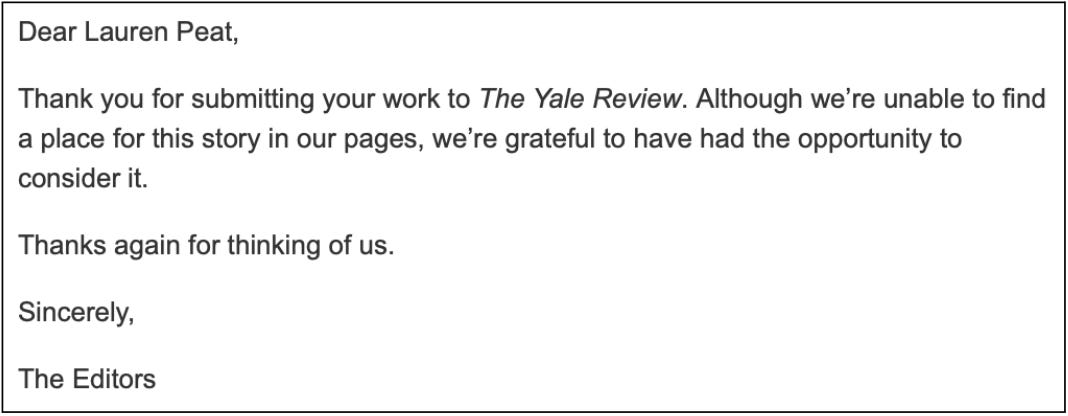
The rejection letter is a challenging genre in its own right. How to let a creative soul down gently! How not to crush their dreams!
As Translation Editor of the poetry magazine Volume, I’ve sent many of these letters. And I’ve received many, many more. (2025 was, by a wide margin, my most fruitful publication year to date, with an acceptance rate of 15%.) It’s essential to normalize this, but today I’m hoping to explore rejection of a different kind.

When I was just a baby writer, around twenty or so, I took a creative writing course with a celebrated Canadian novelist. It was clear he’d rather have been at home writing, but alas—even geniuses gotta eat. And while he didn’t have the emotional generosity to give meaningful feedback on work he found immature, one thing he said, off-the-cuff, has stayed with me.
“One day, Lauren, you might read something you wrote, recognize your own voice, and be repulsed. That’s when you’ll know you’re onto something.” (I always picture him speaking to me directly, though I’m sure he was addressing the entire class.)
Unlike many things I’ve been told about the writing life—that it gets easier, for instance, or that it’s a good idea to share your drafts with as many readers as possible—this has turned out to be true. I don’t remember the first time I recognized my voice on the page and drew back in disgust. But these days, it happens frequently: the lines that seem most real, most resonant, are the lines I most want to cross out.
This shouldn’t surprise me; I’ve been revising my voice for a very long time. When I was eleven, my family emigrated from rural England to downtown Toronto. And because middle schoolers are the worst, I was relentlessly teased for my accent. (In the East Midlands, where I grew up, “Ay up me duck!” is slang for “Hey, how’s it going?”)
I soon began imitating my classmates and teachers, rehearsing words like “water” and “recess” until they came out “right.” Nowadays, people often tell me they don’t detect an underlying accent so much as a certain thoughtfulness in my enunciation—this makes perfect sense. What they’re hearing is the echo of my hyper-vigilance, long since softened into a style I couldn’t undo if I tried.
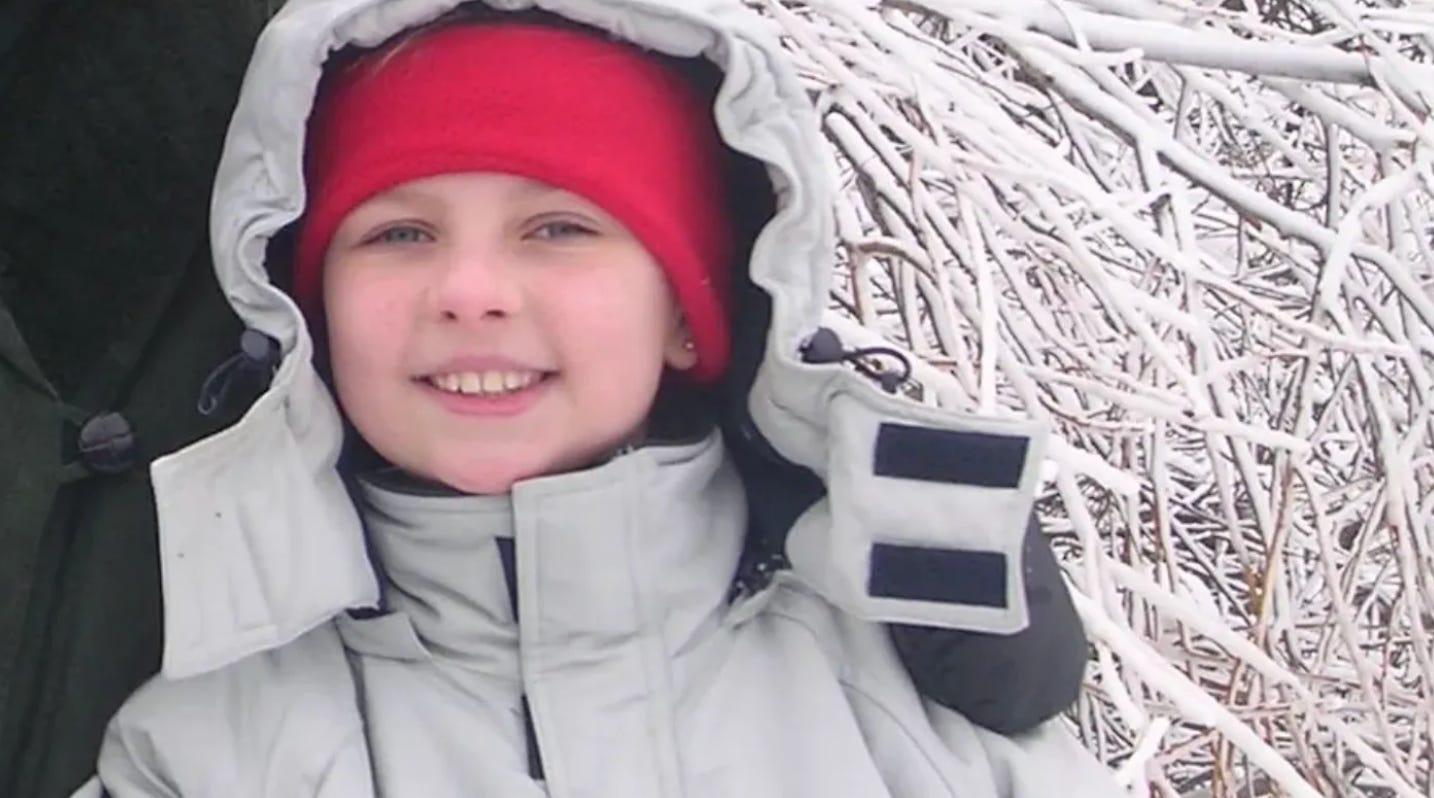
It’s a cliché, really: being bullied doesn’t affect your relationships with other people so much as it affects your relationship with yourself. Whenever I write a line that feels risky, or raw, I’m less frightened by the prospect of repelling others than by the repulsion I sense between me and me: the self who isn’t ready to recognize her voice, and the self who is, already does. Like magnets, the two are impelled into conversation, into reckoning with the hostile energy between them.
Of course, writing isn’t only a pocket mirror. It can be many other things as well: a spur, a caress, a rebuttal, a tarot card, a lantern. A way of stretching the material of our consciousness to see what shapes it can make and contain. And yet art is only possible, I think, when we consent to trying on shapes beyond those we’d most prefer to take.
This might be what my friend meant, all those years ago, when he announced over dinner—thrusting a spring roll into the air, for emphasis—that he was “fed up with beautiful writing.” He paused to douse his baton in plum sauce. “It’s actually very easy,” he said, “to write a pretty poem. Much harder to write an ugly one.”
I intuited something profound in his statement, though I wasn’t ready for it. I was still so invested in writing flattering poems, almost as if I believed they were like selfies—expressions configured to portray their author in her best light.
It is hard to resist—on the page, as in life—the yearning to be liked or desired. But how many times have I turned to Sharon Olds’ Stag’s Leap, a collection that chronicles being left by her husband of thirty years? Or to Oliver de la Paz’s prose poem “Thirty-One Tiny Failures,” about parenting his neurodivergent sons: “When we co-slept with L he would dig his fingers right into our eye sockets.” Writing that reveals, thank God, the honest, unfiltered angles of who we are.
A new acquaintance sent me one such poem last week: a video in which I’m doubled over with laughter, blissfully unaware of being filmed. My first thought was: “UGH. So that’s how I look when I’m really having a good time.”
Recognizing your face, recognizing your voice—it amounts to the same thing, doesn’t it? The work of coming to terms with the shapes of your existence on the earth. The pretty shapes, and the less-than-pretty ones.
So I can’t say I’m walking into 2026 with unshakable self-acceptance. (In 2027, maybe? I’ll keep you posted.) But I can say I’ll be paying attention to these rejections and repulsions like so many weathervanes: signs the winds are blowing in the right direction.
Heartfelt thanks for your readership and support this year; I’m wishing you auspicious inner and outer weather across the next. ⛅

News and upcoming events:
A Pushcart Prize nomination!
“The Ones Who Walk Away”—my essay on Ursula K. LeGuin, ambiguous utopias, and deciding to leave full-time teaching—has been nominated for a Pushcart Prize. Heartfelt thanks to the incredible team at The Seventh Wave. 💜
A feature in Tëmàskwës Miscellany
I recently came across poet D. A. Lockhart’s wonderful post about two poems I published in The Malahat Review in 2024. Here’s an excerpt: “These pieces by Peat catch me in both their honesty and their clarity…. They are, most notably, creations from the earth they grew from.” Much gratitude to D.A., for the treat of being read this way. Be sure to check out his Substack here!
An interview with Dora Prieto and Daniela Rodríguez
I had the great pleasure of interviewing Dora Prieto and Daniela Rodríguez for the latest issue of Volume, about their co-translations of Mexican poet Xitlalitl Rodríguez Mendoza. Read the interview here, and learn what trying to draw a shark has to do with translating a poem…. 🦈
Dead Poets Reading Series
On Sunday, January 11th, from 3–4:45pm, the DPRS is back with readings by Joseph Dandurand, Heidi Greco, Elee Kraljii Gardiner, and Christopher Levenson. Click here for more details.
Beautiful, Lauren. Here's to ugly poems :).
Congratulations on the Pushcart nomination, Lauren. Nice work. :)